God of Kings


S. Rajesh,
Tamilnadu - India
Email: rajes1@gmail.com


free counters


Wednesday, August 31, 2011

Ancient Punch Mark Coins

FIGURES IN PUNCH MARK COINS

Various punches of animals, humans, mountains, rivers etc were punched on the punch mark coins on both the sides of the coin. Some of them are shown here.


 THE BEGINNING

When did Coinage begun?

It started on both sides of the Ancient World - in China and in Lydia, in Asia Minor, at more or less the same time, about 700 years before Christ or 700 B.C. Coinage in INDIA begun about 6th century B.C. Many historians argue that Indian coinage existed prior to 6th century B.C in the Indus valley civilization of "Mohenjo-Daro and Harappa" between 2500 BC and 1750 BC. There, however, is no consensus on whether the seals excavated from the sites were in fact coins.

Seals found in Mohenjo-Daro


To the ancient Indians, a coin was not a piece of inanimate metal with an official stamp, but a form (rupa) pulsating with symbols, names of kings, gods and goddesses portraying wealth and prosperity. Each dynasty and even each king contributed his own innovation to the coinage resulting in a bewildering variety of Indian coins. The Kings chose such symbols, forms of gods and goddesses and legends which were a part of, social consciousness that the users of the coins could easily understand and appreciate. 

The various symbols used on ancient punch mark coins are shown below:-


The establishment of Numismatic Society of India in 1910 is an important landmark in the study of Indian Coins.

PUNCH-MARK COINS

As the name suggests, these coins bear the symbols of various types, punched on pieces of silver of specific weight. Punch-marked coins are marked with 1-5 (and sometimes more) marks representing various symbols. They are broadly classified into two periods: the first period (attributed to the Janapadas or small local states) and the second period (attributed to the Imperial Mauryan period). The motifs found on these coins were mostly drawn from nature like the sun, various animal motifs, trees, hills etc. and some were geometrical symbols.

Ancient Indian coinage was based on `Karshapana' unit that consists of 32 rattis (3.3 grams of silver) and a 'Ratti' is equivalent to 0.11 gms.


Cup Shaped PMC Coins

Silver Bent Bar Coins


Multiple Punch Coins

COINS OF JANAPADAS

Kuntala Janapadas 6th century BC, Silver, 6.24 g, pulley type with a big pulley-type symbol in the center and a clock-wise Triskeli in two of its orbs (Uniface)


Imperial Magadha 5th century BC, Silver, Karshapana, 5 symbols
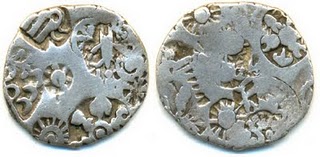
 
Magadha: multiple punches seen

 
Vidarbha a square copper with three arched hills & crescent in a circle enclosed in a double square. 11.7 gms
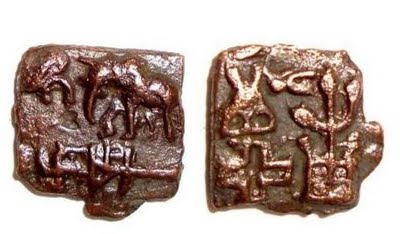
 Ancient copper coin with various symbols


JANAPADAS (OR) STATES

The silver punch mark coins have been found all over the country. The earliest of these were issued by janapadas and mahajanapadas which existed after the Bharat war (11th century B.C) .All these gradually merged with the expanding Magadha Empire by 4th century B.C. The states (janapadas) of which coins are known so far are:

(a) Surasena - Modern Braj, the region around Mathura
(b) Uttara Panchala - the Rohilkhand region
(c) Dakshin Panchala - the Doab area stretching from Ganga to
Chambal
(d) Chedi - the region south of Yamuna
(e) Kosala - the area bounded by Gomti on the west, Sarpika-modern
sai on the south, Sadanira-modern gandak on the east and Nepal hills on the north.
(f) Kasi- the region around Varanasi
(g) Malla - dist of Deoria and surroundings
(h) Magadha - area bound by Ganga on the north, Son on the west,
plateau of Chota Nagpur to the south and Bhagalpur region to the east.
(i) Vanga - Bengal
(j) Dakshina Kosala - western Orissa and eastern Madhya Pradesh
(k) Andhra - the delta of Godavari and Krishna
(l) Asmaka - area on both sides of Godavari bordering Andhra Pradesh
(m) Avanti - Ujjain region
(n) Surashtra - the Kathiawar region
(o) Gandhara - north western region on border of Afghanistan
(p) Kuntala - Satara region, western maharastra


City of Taxila
 Observe:         Three “Double Paddles” crossing a central circle. Two counter-marks:
Three dots within a circle, overlapping a sun, of which only a half is still visible.

 Reverse:         Blank
Kingdom of Avanti


Observe:         Four Symbols.


Reverse:         Blank
Kingdom of Sunga

Kingdom of Kasi

Observe:         Two large and small punches.


Reverse:         Four small punches of which only a windmill sail pattern is

recognizable.
Mauryan Empire / Kingdom of Sunga

Mauryan Empire / Kingdom of Sunga

Mauryan Empire / Kingdom of Sunga

Mauryan Empire / Kingdom of Sunga

Mauryan Empire

Mauryan Empire / Kingdom of Sunga

Mauryan Empire / Kingdom of Sunga

Mauryan Empire / Kingdom of Sunga

Mauryan Empire / Kingdom of Sunga

Mauryan Empire / Kingdom of Sunga

Mauryan Empire / Kingdom of Sunga

Mauryan Empire / Kingdom of Sunga

Mauryan Empire / Kingdom of Sunga

Kingdom of Sunga

Kingdom of Sunga

Kingdom of Sunga

Modern Forgery Coin

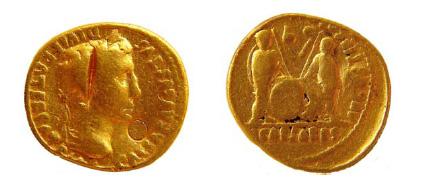
Roman Coin – Augustus, 27 BC – Ad 14 (7.73 Gram – approx.)


Error Coins

These days’ coins are produced on a large scale to meet the requirements of the users, resulting in Minting Errors on coins. The Mint weeds out these coins and puts them back to melting, but still many escapes. These coins are known as Error Coins or defective specimens and are eagerly sought by collectors.

Lets check out what these Error Coins are and how do they look like?

The most common Errors in minting coins are:-

1. Discoloration of the Face.
2. Chipping of the surface.
3. Broken Edges.
4. Off-center or double striking.
5. Miss-stuck coins
6. Die rotation etc.

BROCKAGES (Lakhi Coins)

They are specimens of coins that are found with normal design on one side and the same design incused or stamped on the other side also. Remember the coin that Amitabh (Big B) uses in movie Sholey with both sides having 'Heads'. They are also called as Lakhi coins.


Why this happens? This happens when the coin last struck in the chain getting lodged in the die and then another blank comes into position and is stuck. The second coin gets the normal impression on one side and the impression from the face of the previous coin (still stuck in the die) on the other.

BLANK PLANCHET -
I wonder how these got away.

One Rupee was supposed to be minted on it!


MULTIPLE - STRUCK COINS

We also come across ‘multiple-struck' coins e.g. generally we see double struck coins/off centre coins. This happens as a result of a coin not being ejected from the coining press after the first striking, and getting a second strike. Then again, if the planchet slips out of place before striking, it receives an impression which is out of alignment. Off centre coin is a coin struck out of alignment, caused by the planchet slipping out of place before being struck.

Multiple Strikes: (So is it now 5 Paise or 10 Paise?)


OFF-CENTRE STRIKE : Massive Off-centre 2 rupee coin


MULES

An interesting variety of miss-struck coins are the 'Mules'. This term is used to describe coins which have the obverse die of one coin and reverse die of another. Mules are sometimes produced at the time of re-striking coins of earlier periods/issues. Unless the obverse and reverse dies are properly paired at the time of re striking, the coins struck may have the wrong obverse or reverse. Most instances of 'mules' are found in coins of Queen Victoria, which bear dates 1877-1901 and yet have the legend Victoria Queen on the obverse. This one has Victoria Empress with date 1876.


1862 Rupee (4 dots): In 1862 some rupee coins were minted by Half Anna die obverse. This probably happened as the size of rupee coin and Half Anna coin was same. Half Anna die was fitted to rupee minting operation and resulted in such interesting variety. Shown below is the mule with the original Half Anna.


EDGE ERRORS

Another type of error come across are specimens with upright milling in coins which normally have a 'security edge', It should be noted, coins having 'security edge' are first struck with the usual upright, or straight milling at the time the obverse and reverse designs impressed upon them. These are next passed through a second press where the indented groove is put on the edge, under pressure, while being fed into the second machine, if a few coins accidentally skip the press, unless weeded out at the Mint, these may go a circulation with normal upright milling.


1918 Rupee: Uni-face "The Uni-face 1918 rupee, with its milled edge, is a genuine Mint error. I have no doubt that it was the lower of 2 planchets which arrived in the striking chamber at the same time".


20 Paise:One side Blank


Wrong Date on coin (It was again Minted in 1997-correct date)


Different Metal Error? 1940 Half Rupee-Brass?


DIE ROTATION ERROR: The Obverse Die rotation to Right Side


Die Rotation is a minting error in which the Obverse/reverse Die is rotated, anywhere from 5-180 degrees clockwise or anticlockwise.


Some 1835 1/4 Anna coins are found with 180degree rotation, but they are not errors. They were minted like that, as the British way of seeing the other side of the coin was to flip the coin upside down rather than sideways.


DIE CRACK ERROR: When coins are minted using broken die or if during the minting process the die breaks/chips, the coins minted in that process are known as die crack error coins.


GHOSTING ERROR: The impression of the obverse die is seen on reverse side also.


Can anyone tell what happened to this coin?


To Learn More about Coins Click here - www.bharatcoins.com


Saturday, August 13, 2011

Fake Coins - Caution


Investigations into the first-ever busting of a gang running a business of fake coins gang has led Delhi Police to ask for help from central investigating agencies because a foreign hand appears to have played a prominent role.

Delhi Police sources said, “A fake minting unit had come up at Veerganj in Nepal showed a very "professional” group was behind the entire operation. There was about Rs 1 crore worth of fake coins have entered the country through eastern UP. We are in talks with the Reserve Bank and seeking their cooperation in identifying the fake coins already in circulation. It is quite similar to the one used to transport currency notes to India. The aim is to destabilize the economy. Such small denominations do not attract much attention of the agencies”.

On August 9, south district police busted an international network of criminals involved in minting Indian coins in Nepal and introducing the counterfeit currency into India through big food joints in Delhi, Gurgaon and other metropolitan cities. Two men were arrested — Sudhir Kumar (36) and Daleep Kumar (29). So far, 41,600 counterfeit coins of Rs 10 denomination have been recovered. A Maruti car used to transport the currency has been recovered.

But the main accused — Mangat Joshi who allegedly headed the Delhi operations — is still at large along with at least three other men.The gang allegedly carried operations from the Rohini area in outer Delhi. These coins of Rs. 10 are in circulation in

Delhi and shops and food joints where small coins are required in large quantity. These joint owners have told us that they were approached by the accused who promised to provide them loose currency at a very low exchange rate right at their doorstep. They don’t have to send a person each morning to get the change convinced these owners to settle for this method of operation.. A total of Rs 4.16 lakh worth of fake coins have so far being recovered. They are being questioned on whether they had any inkling that these coins were fraud”.

The one of the accused have disclosed that the gang consisted of around 8-10 members including some Nepali nationals. Sudhir and other members of this gang would stay in Hotel Navraj in Janak Puri, Nepal where one Nepali person would come in a Pajero and deliver Indian counterfeited coins of Rs 10 denomination to his Indian counterparts putting up in the hotel.

Thanks to http://www.latestsamachar.com
===================================================================

Never buy old coins from people who sell them on streets, because most of them are fake. Buy coins from a genuine dealer who has a shop and participates in coin exhibitions. If you have doubts about the genuinely of coins then go to a good reputed coin dealer and show your coins to that person, but also bear one thing in mind that if you have a rare coin and you don't know anything about it the person you show your coins may say it is a fake and buy it from you at a low price. This thing happens, so before buying any coin study about that coin on the internet or refer to books which give you information about the coin you want to purchase.

And some coins with date of 1616, 1717, 1818,  and also 1839 written on it! Apparently the faker forgot the period for which the East India Company ruled India. We know that 1616 was in the Muslim King Jahangir era and the East India Company did not rule India then, though it did set up trade. And in 1939, we know very well that in 1939, George VI was the emperor of India and India was very close to getting its independence. So there is no way these coins had been in circulation in the East India company era, that is established beyond doubt. The deities on these coins are worshiped, but the East India Company never had any reason to mint coins having these deities on them , and never did so.

There is a big fake coin market in Johri Baazar Jaipur. -- So Careful Dear Coin Collectors

Do you collect coins visit and check the year, mint details -
http://republiccoins.indian-coins.com
&
http://www.IndianCoins.org/Encyclopedia/Intro_Ind_Coin_Forgeries.pdf


I have display some fake coins images below


do you want more details Please visit: http://beekar-the-numismatist.blogspot.com/p/fake-coins-of-india.html